

Introduction
Many people are surprised to learn that Minnesota has elevated landscapes, rocky hills, scenic bluffs, and rugged highlands. A common question asked by travelers and nature lovers is, “How many mountains are in Minnesota?” The answer is more complicated than many people expect because Minnesota does not contain large mountain ranges like Colorado or Montana.
Minnesota is best known for its lakes, forests, rivers, and peaceful outdoor scenery. However, the state also features several elevated regions that many visitors describe as mountain-like. Although Minnesota does not have towering alpine peaks, it still offers beautiful hiking destinations, cliffs, rocky ridges, and scenic overlooks that attract outdoor enthusiasts throughout the year.
The northeastern part of the state near Lake Superior contains the roughest and highest terrain in Minnesota. Areas such as Eagle Mountain, the Sawtooth Mountains, and the North Shore Highlands provide dramatic natural landscapes and outdoor adventures. These regions may not compare in size to the Rocky Mountains, but they still offer impressive views and rugged wilderness experiences.
This detailed guide explains how many mountains are in Minnesota, how mountains are classified, the state’s most famous peaks, and why Minnesota’s landscape remains one of the Midwest’s greatest natural treasures.
Does Minnesota Actually Have Mountains?
Minnesota does not have major mountain ranges like the Rockies, Appalachians, or Sierra Nevada Mountains. The state lacks extremely tall peaks and alpine environments.
However, Minnesota does contain elevated rocky regions, cliffs, hills, ridges, and highlands that some people consider mountains.
The state’s landscape includes:
- Rocky bluffs
- Forested hills
- Elevated ridges
- Scenic overlooks
- Steep terrain
- Highlands near Lake Superior
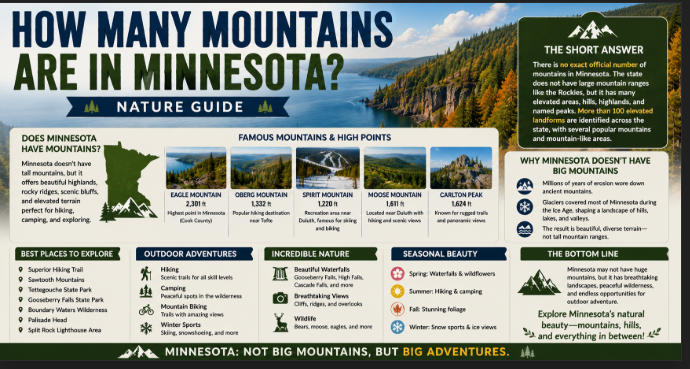
Because mountain definitions vary, there is no exact official number of mountains in Minnesota.
How Many Mountains Are in Minnesota?
There is no universally accepted official count of mountains in Minnesota because many of the state’s elevated areas are classified differently.
Some geographic databases and hiking resources identify more than 100 named elevated landforms across Minnesota. However, many of these are technically hills, ridges, bluffs, or highlands rather than true mountains.
Minnesota’s landscape is generally considered hilly instead of mountainous.
Still, several named locations include the word “mountain,” including:
- Eagle Mountain
- Oberg Mountain
- Moose Mountain
- Spirit Mountain
- Carlton Peak
- Sawtooth Mountains
Although these locations are relatively small compared to western mountains, they remain important natural attractions within the state.
Why Minnesota Does Not Have Large Mountains
Minnesota’s geography was shaped by ancient geological processes and glaciers.
Millions of years ago, older mountain systems likely existed in parts of the region. Over time, erosion gradually wore them down.
Later, glaciers covered most of Minnesota during the Ice Age. These glaciers flattened the terrain and created:
- Lakes
- Valleys
- Rolling hills
- Rocky ridges
- Forest landscapes
As a result, Minnesota developed a landscape with moderate elevations instead of towering mountain ranges.
Eagle Mountain: Minnesota’s Highest Point
The highest natural point in Minnesota is Eagle Mountain.
Eagle Mountain Facts
- Elevation: 2,301 feet
- Location: Cook County
- Region: Northeastern Minnesota
- Nearby Wilderness Area: Boundary Waters
Although Eagle Mountain is small compared to western peaks, it remains one of Minnesota’s most popular hiking destinations.
Hiking Eagle Mountain
Hiking Eagle Mountain is a favorite activity for outdoor enthusiasts.
The trail includes:
- Forest paths
- Rocky terrain
- Streams
- Scenic viewpoints
- Wildlife sightings
The hike is moderately challenging and offers a rewarding wilderness experience.
The Sawtooth Mountains
The Sawtooth Mountains are located along Minnesota’s North Shore near Lake Superior.
Despite the name, they are not true mountains by western standards. However, the area features steep ridges and dramatic rocky landscapes.
Features of the Sawtooth Mountains
- Forested hills
- Scenic cliffs
- Hiking trails
- Waterfalls
- Lake Superior overlooks
This region is considered one of the most scenic parts of Minnesota.
Other Mountain-Like Areas in Minnesota
Minnesota contains several elevated destinations that provide mountain-like scenery.
Oberg Mountain
Oberg Mountain is a well-known hiking area offering incredible views of forests and lakes.
The trail is especially popular during autumn when leaves change color.
Moose Mountain
Located near Duluth, Moose Mountain provides elevated terrain and outdoor recreation opportunities.
Spirit Mountain
Spirit Mountain is famous for skiing, mountain biking, and outdoor adventure sports.
It is one of Minnesota’s best-known recreation areas.
Carlton Peak
Carlton Peak features rugged hiking trails and panoramic views near Lake Superior.
Why Definitions Matter
One reason it is difficult to count Minnesota’s mountains is because mountain definitions vary.
Some experts define mountains based on:
- Elevation
- Steepness
- Geological formation
- Prominence above nearby land
Since Minnesota’s peaks are relatively low in elevation, many are classified as hills or highlands rather than mountains.
Minnesota’s Highest Elevations
Although Minnesota lacks giant peaks, several locations still reach impressive heights for the Midwest.
Highest Points in Minnesota
- Eagle Mountain — 2,301 feet
- Misquah Hills area — elevated highlands
- Sawtooth region — rugged terrain
- Iron Range highlands — rocky elevations
These regions create some of the state’s most beautiful natural scenery.
Minnesota Compared to Mountain States
Minnesota’s terrain differs greatly from western mountain states.
Colorado
Colorado contains peaks exceeding 14,000 feet.
Montana
Montana features massive mountain ranges and alpine wilderness.
California
California contains the Sierra Nevada Mountains and towering cliffs.
Minnesota
Minnesota’s highest point reaches only 2,301 feet.
However, Minnesota still offers impressive outdoor recreation and scenic beauty.
Why Visitors Love Minnesota’s Highlands
Even without giant mountains, Minnesota attracts nature lovers from across the country.
Popular attractions include:
- Hiking trails
- Forest landscapes
- Lake Superior views
- Waterfalls
- Camping areas
- Wildlife habitats
The peaceful environment and scenic beauty create unforgettable outdoor experiences.
Best Hiking Areas in Minnesota
Minnesota contains many excellent hiking destinations.
Superior Hiking Trail
This famous trail stretches along the North Shore and passes through forests, ridges, and scenic overlooks.
Tettegouche State Park
Known for cliffs, waterfalls, and hiking opportunities.
Gooseberry Falls State Park
A popular destination featuring waterfalls and forest trails.
Boundary Waters Wilderness
Offers rugged terrain, camping, canoeing, and nature exploration.
Waterfalls and Cliffs in Minnesota
Minnesota’s elevated regions include many beautiful waterfalls and cliffs.
Popular Waterfalls
- Gooseberry Falls
- High Falls
- Cascade Falls
- Devil’s Kettle Falls
These attractions create dramatic scenery similar to mountainous regions.
Outdoor Activities in Minnesota’s Elevated Areas
Minnesota’s rugged regions support many outdoor activities.
Hiking
Thousands of miles of trails cross forests and highlands.
Camping
Northern Minnesota offers peaceful wilderness camping.
Skiing
Winter snowfall supports skiing and snowboarding.
Mountain Biking
Several trails provide exciting biking experiences.
Photography
The state’s landscapes are perfect for nature photography.
Wildlife in Minnesota’s Highlands
Northern Minnesota contains diverse wildlife populations.
Animals commonly found include:
- Black bears
- Deer
- Moose
- Wolves
- Eagles
- Foxes
The forests and wilderness areas create excellent habitats for wildlife.
Seasonal Beauty in Minnesota
Each season transforms Minnesota’s landscape.
Spring
Waterfalls become powerful due to snowmelt.
Summer
Perfect for hiking and camping.
Fall
Autumn colors make forests incredibly beautiful.
Winter
Snow creates excellent conditions for winter sports.
Geological History of Minnesota
Minnesota’s landscape developed over billions of years.
Ancient volcanic activity and glaciers shaped the terrain into its current form.
The rocky formations near Lake Superior are among the oldest exposed rocks in North America.
This geological history explains why Minnesota contains rugged highlands instead of tall mountain ranges.
Are Minnesota Mountains Difficult to Climb?
Most hiking areas in Minnesota are easier than major mountain climbs in western states.
However, some trails include:
- Rocky paths
- Steep inclines
- Uneven surfaces
- Long hiking distances
Visitors should still prepare properly for outdoor adventures.
Hidden Scenic Destinations
Several lesser-known locations offer incredible scenery.
Palisade Head
A dramatic cliff overlooking Lake Superior.
Split Rock Lighthouse Area
Known for cliffs and stunning lake views.
Temperance River State Park
Features rocky canyons and waterfalls.
North Shore Scenic Drive
One of the Midwest’s most beautiful road trips.
Benefits of Minnesota’s Landscape
Minnesota’s moderate terrain provides many advantages.
Family-Friendly Hiking
Trails are accessible for beginners.
Less Crowded Parks
Outdoor areas are often quieter than famous mountain destinations.
Beautiful Nature
The combination of forests, lakes, and cliffs creates unique scenery.
Four-Season Recreation
Every season offers different outdoor activities.
Common Misconceptions About Minnesota
Many people assume Minnesota is completely flat.
In reality, the state includes:
- Hills
- Rocky ridges
- Cliffs
- Forested highlands
- Scenic valleys
While Minnesota lacks giant mountains, its terrain is far more diverse than many visitors expect.
Why Minnesota’s Mountains Matter
Even though Minnesota’s mountains are relatively small, they still play an important role in tourism and outdoor recreation.
These elevated areas support:
- Hiking tourism
- Wildlife habitats
- Winter sports
- Photography
- Camping adventures
They also contribute to the state’s natural beauty and environmental diversity.
Is Minnesota Worth Visiting for Mountain Lovers?
Minnesota may not satisfy travelers seeking giant alpine peaks, but it still offers excellent outdoor experiences.
Visitors can enjoy:
- Scenic overlooks
- Forest hiking
- Rugged cliffs
- Waterfalls
- Peaceful wilderness
- Lake Superior landscapes
The natural beauty of northern Minnesota surprises many first-time visitors.
Conclusion
So, how many mountains are in Minnesota? There is no exact official number because many elevated areas are classified as hills, ridges, or highlands instead of true mountains. However, Minnesota contains numerous named peaks and rugged landscapes that provide mountain-like scenery and outdoor adventure opportunities.
The state’s most famous high point, Eagle Mountain, along with the Sawtooth Mountains and North Shore Highlands, creates some of the Midwest’s most beautiful natural scenery. While Minnesota lacks giant mountain ranges like Colorado or Montana, it still offers incredible hiking, camping, waterfalls, cliffs, and forest landscapes.
Minnesota proves that you do not need towering peaks to experience breathtaking nature and unforgettable outdoor adventures.
